

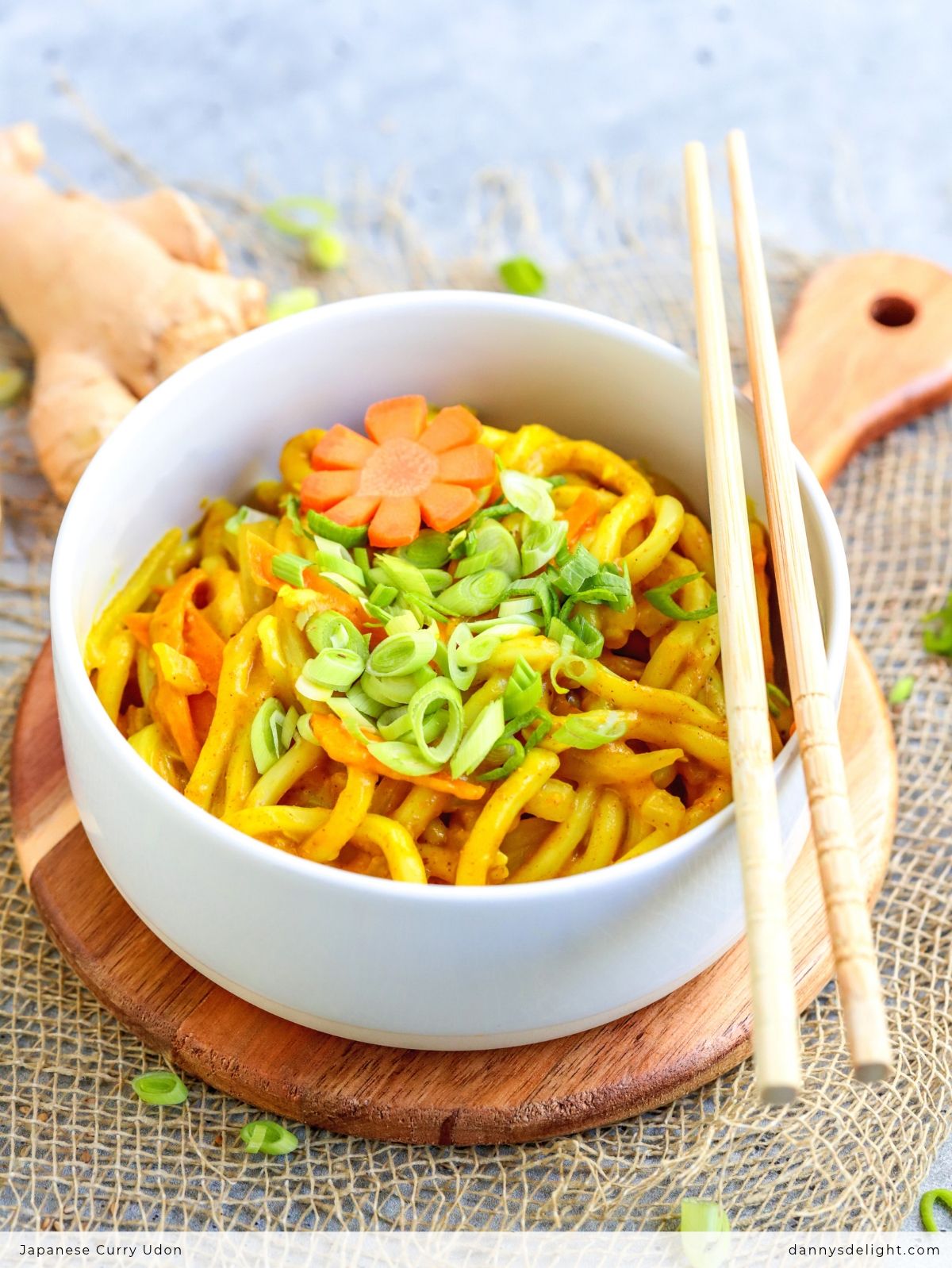
This Japanese Curry Udon brings together thick, chewy udon noodles and a rich curry sauce with onion, celery, ginger, and garlic. The sauce starts with a simple homemade curry roux made from olive oil, flour, curry powder, and garam masala, then vegetable broth turns everything into a smooth, glossy curry that clings beautifully to the noodles.
It is warm, comforting, completely plant-based, and comes together in about 25 minutes, which makes it a very handy recipe for those nights when I want something substantial without a long cooking session.
Try my Asian Udon Noodle Soup recipe.
Why You’ll Love This Recipe
- Ready in about 25 minutes: Great for an easy weeknight meal.
- Thick, chewy noodles: Fresh udon works beautifully with the creamy curry sauce.
- Homemade curry roux: No packaged curry blocks are required.
- Plenty of flavor: Ginger, garlic, curry powder, and garam masala create a warm, savory sauce.
- Plant-based: Made entirely with vegetable broth and plant-based ingredients.
- Easy to customize: Add more vegetables or your favorite tofu.
- Comforting: Thick noodles and warm curry are a pretty reliable combination when you’re hungry.
Try my 20-Minute Udon Stir Fry recipe.
What You’ll Need to Make Japanese Curry Udon
For the vegetables:
- 1 tablespoon olive oil
- 1 tablespoon minced fresh ginger
- 1 garlic clove, minced
- ½ yellow onion, thinly sliced
- 1 celery stalk, finely diced
For the curry:
- 3 tablespoons olive oil
- 3 tablespoons all-purpose flour
- 1 tablespoon curry powder
- 1 teaspoon garam masala
- ½ teaspoon sea salt
- 1 pint (2 cups / 480 ml) vegetable broth
- 14 ounces (400 g) fresh udon noodles
- 2 green onions, thinly sliced, for garnish
What You’ll Need to Do
- Prep Time: 10 minutes
- Cook Time: 15 minutes
- Total Time: 25 minutes
- Serves: 2

- Grab a medium or large pot and place it over medium heat.
- Add 1 tablespoon olive oil and let it warm.
- Toss in the minced ginger and garlic.
- Cook for about 1 minute, stirring so the garlic doesn’t catch on the bottom.
- Add the sliced onion and cook for another minute.
- Add the diced celery and keep cooking for about 3 minutes, or until the vegetables have softened.
- Transfer the vegetables to a plate and set them aside for now.
- Keep the same pot on the stove because we’re going to build the curry sauce right in there.
- Add the remaining 3 tablespoons olive oil.
- Once the oil is warm, whisk in the flour, curry powder, garam masala, and sea salt.
- Cook the mixture for about 1 minute, whisking constantly. This cooks out the raw flour taste and gives the spices a chance to wake up.
- Start adding the vegetable broth gradually.
- Add just a little broth at first and whisk until completely smooth.
- Keep adding the broth in small amounts, whisking each time before adding more. Taking your time here is the easiest way to avoid a lumpy curry sauce.
- Once all the broth has been incorporated, increase the heat to medium-high.
- Continue whisking for about 1–2 minutes, until the curry starts bubbling and thickens into a smooth sauce.
- Return the cooked vegetables to the pot.
- Reduce the heat to low and let the curry stay warm while you prepare the noodles.
- Bring a separate pot of water to a boil.
- Add the fresh udon noodles and cook them for about 1 minute less than the package directions recommend.
- Fresh udon usually cooks very quickly, so keep an eye on it.
- Drain the noodles well.
- Add the drained udon directly to the curry sauce.
- Gently toss until all those lovely thick noodles are coated in curry.
- Let everything cook together for another 1 minute so the noodles finish cooking in the sauce.
- Divide the Japanese Curry Udon between two bowls.
- Sprinkle plenty of sliced green onions over the top and serve immediately.
Try my Creamy Coconut Udon with Mushroom recipe.
Easy Ingredient Swaps
Fresh udon: Frozen udon works very well. Dried udon can also be used, but cooking time will be longer.
Yellow onion: White onion or shallot will work.
Celery: Try thinly sliced carrots, mushrooms, or bell peppers.
All-purpose flour: A suitable gluten-free flour blend can be used if needed, although the sauce texture may vary slightly.
Vegetable broth: Use a low-sodium vegetable broth if you prefer greater control over seasoning.
Olive oil: Avocado oil or another neutral cooking oil can be substituted.
Try my 15-Minute Peanut Udon recipe.
Some Twist and Tweak Ideas
Add sliced mushrooms with the vegetables.
Stir in baby spinach just before serving.
Add cubed tofu for a more substantial meal.
Add steamed broccoli.
Mix in thinly sliced carrots.
Add peas near the end of cooking.
Use a little extra curry powder for a stronger curry flavor.
Add chili flakes or chili oil if you like some heat.
Stir in a teaspoon of soy sauce or tamari for extra savory flavor.
Add a tiny bit of maple syrup if you enjoy the slightly sweet character commonly found in Japanese-style curry.
Try my Vegan Udon Noodle Soup recipe.
Some Helpful Tips
Have the broth ready before starting the roux. Once the flour goes into the oil, things move quickly.
Add the broth gradually. Dumping all the broth in at once makes lumps much more likely.
Whisk continuously. A smooth roux makes a smooth curry.
Don’t overcook fresh udon. These noodles can soften very quickly.
Finish the noodles in the curry. Cooking them for the final minute directly in the sauce helps everything come together.
Watch the sauce consistency. Curry thickens as it sits. Add a splash of broth if it becomes too thick.
Try my Orzo Chicken Comfort Soup recipe.
Why Making a Roux Works So Well
The olive oil and flour create the base that gives this Japanese-style curry its thick, smooth texture.
Cooking the flour briefly removes its raw flavor, while heating the curry powder and garam masala in the oil helps release their aroma.
Then the vegetable broth is gradually whisked in.
The result is a sauce thick enough to cling to those chunky udon noodles rather than collecting at the bottom of the bowl.
Try my High Protein Broccoli Soup recipe.
Some Budget-Friendly Tips
Fresh udon is often available inexpensively at Asian grocery stores.
Buy larger containers of curry powder rather than individual spice packets.
Use store-brand vegetable broth.
Onion and celery are inexpensive vegetables, but you can also use whatever vegetables need using up.
Homemade vegetable broth can reduce the cost further.
Skip additional toppings and simply use green onion for an inexpensive finish.
Try my Speedy Beef Chow Mein recipe.
Some Serving Ideas

Serve Japanese Curry Udon with:
- Steamed broccoli
- Sautéed mushrooms
- Bok choy
- Edamame
- Crispy tofu
- Cucumber salad
- Pickled vegetables
- Shredded cabbage
- Steamed green beans
- Chili oil
- Sesame seeds
- Extra green onions
It is hearty enough to serve on its own, but adding tofu and vegetables can turn it into an even more substantial meal.
Great for a Quick Weeknight Dinner
Fresh udon is one of the reasons this recipe comes together so quickly.
The noodles need only a short time in boiling water, while the curry sauce itself takes just a few minutes once the vegetables are cooked.
If you chop everything before starting, dinner can realistically be on the table in around 25 minutes.
Some Storage and Reheating Tips
Store leftovers in an airtight container in the refrigerator for up to 3 days.
The noodles will continue absorbing some curry sauce while refrigerated, so the dish will become thicker.
When reheating on the stovetop, add a splash of vegetable broth or water.
Warm gently over medium-low heat while stirring occasionally.
Individual portions can also be reheated in the microwave.
Avoid overheating the udon because it can become overly soft.
For the best texture, this dish is definitely at its best freshly made.
If preparing ahead, consider storing the curry sauce and cooked noodles separately and combining them when reheating.
Final Thoughts
This Japanese Curry Udon is basically comfort food in noodle form.
The curry sauce is warm, thick, and aromatic, while fresh udon brings that soft, wonderfully chewy texture that makes the whole bowl particularly satisfying.
Ginger, garlic, curry spices, vegetables, and green onion keep the recipe flavorful without making it complicated. And since the whole thing takes about 25 minutes, it’s an easy one to pull out whenever a bowl of curry noodles sounds like exactly the right dinner.
Japanese Curry Udon
This easy Japanese Curry Udon combines thick noodles, ginger, garlic and vegetables in a rich homemade curry sauce for a cozy vegan meal.

Ingredients
For the vegetables:
For the curry:
Instructions
-
Heat 1 tablespoon olive oil in a large pot over medium heat.
-
Add the minced ginger and garlic and sauté for approximately 1 minute, stirring frequently.
-
Add the sliced onion and cook for an additional minute.
-
Add the diced celery and continue cooking for approximately 3 minutes, or until the vegetables are tender.
-
Transfer the cooked vegetables to a plate and set aside.
-
Add the remaining 3 tablespoons olive oil to the same pot and warm over medium heat.
-
Whisk in the all-purpose flour, curry powder, garam masala, and sea salt.
-
Cook for approximately 1 minute, whisking continuously to cook the flour and release the aroma of the spices.
-
Gradually add the vegetable broth in small amounts, whisking continuously after each addition to prevent lumps.
-
Once all the broth has been incorporated, increase the heat to medium-high.
-
Cook for approximately 1–2 minutes, whisking continuously, until the curry sauce thickens and begins to bubble.
-
Return the cooked vegetables to the curry sauce and reduce the heat to low.
-
Meanwhile, bring a separate pot of water to a boil.
-
Add the fresh udon noodles and cook for approximately 1 minute less than the package directions specify.
-
Drain the noodles thoroughly and add them directly to the curry sauce.
-
Stir gently until the noodles are completely coated with the curry.
-
Cook for an additional 1 minute.
-
Divide the curry udon evenly between two bowls.
-
Garnish with sliced green onions and serve immediately.
Nutrition Facts
Servings 2
- Amount Per Serving
- Calories 580kcal
- % Daily Value *
- Total Fat 28g44%
- Sodium 1500mg63%
- Total Carbohydrate 70g24%
- Dietary Fiber 5g20%
- Sugars 5g
- Protein 10g20%
* Percent Daily Values are based on a 2,000 calorie diet. Your daily value may be higher or lower depending on your calorie needs.
Note
- Estimated GI: ~55
- Estimated GL per serving: ~36


